Crypto Take Profit Levels: A Step-by-Step Guide


Table of Contents
Most traders do not lose because they pick the wrong coin. They lose because they have no rule for selling the winner. You ride a 40% move, watch it round-trip back to break-even, and tell yourself you'll do better next time. You won't — not without a system.
This guide gives you a simple formula for crypto take profit levels before you enter the trade. No emotion. No "let me see how it feels." Just a repeatable framework you can apply to your next setup, whether it's BTC at $90,000 or a low-cap altcoin running on momentum.
What Are Crypto Take Profit Levels?
A take profit level is the exact price where you close some or all of your position to lock in gains. A take profit order is the actual instruction sitting on the exchange that triggers automatically when that price prints. The level is your decision. The order is the execution.
Pre-planned exits outperform emotional selling for one reason: by the time price is moving fast, your judgment is already compromised. Greed pushes targets higher. Fear pulls them lower. A take profit order set before you enter removes both.
Take Profit Orders vs. Limit Sells: What Is the Difference?
A limit sell sits passively at a price waiting to fill. A take profit order on most exchanges — Binance, Bybit, OKX — is a conditional order tied to your open position that fires a market or limit sell when triggered. Functionally similar for spot. On futures, take profit orders close the position and reduce risk automatically; standalone limit sells do not.
Why Most Traders Never Set a Take Profit Level Before Entering
Because it forces you to commit to being wrong about how high it could go. Setting a target at $95,000 means accepting you'll miss the move to $110,000. That discomfort is exactly why 90% of retail traders skip the step — and exactly why they give gains back.
How to Calculate Take Profit Levels Step by Step
Here is the formula. Memorize it. Apply it to every trade before you click buy.

Step 1: Define Your Entry Price and Stop-Loss First
You cannot calculate a take profit without knowing your risk. Pick your entry — say BTC at $90,000. Place your stop below the nearest structural level — say $87,300. Your risk per unit is $2,700, or roughly 3%.
Step 2: Apply a Minimum Risk/Reward Ratio (1:2 and Beyond)
Risk/reward ratio is non-negotiable. If you're risking $100, your first take profit should target at least $200 (1:2). For trend trades, push to 1:3 or 1:4. Back to the BTC example: $2,700 risk × 2 = $5,400 reward, putting your first target at $95,400. A 1:3 target sits at $98,100.
Why does this matter? With a 1:2 risk/reward ratio, you only need to win 40% of your trades to be profitable. With 1:3, that win rate drops to 30%. Math does the work for you.
Step 3: Cross-Reference Your Target With Market Structure
A calculated target is worthless if it sits inside a wall of resistance. Pull up the daily and 4-hour charts. If your math says $95,400 but there's a six-month supply zone at $94,200, move your target down. Take the structure-based fill. Greed at this stage kills more trades than bad entries.
Step 4: Adjust for Fees, Slippage, and Tax Drag on Real Returns
Bybit's official documentation confirms the taker fee on perpetuals is 0.055%. Round-trip on a leveraged position, that's 0.11% before slippage. On a $10,000 position with 10x leverage, you're paying $11 in fees per trade just to play. Now factor in 0.05% slippage on volatile alts and short-term capital gains tax in many jurisdictions, and a "1:2" trade can quietly become a real 1:1.7.
The fix: bump your minimum risk/reward ratio to 1:2.5 to absorb friction. Use limit orders for take profits instead of market orders to capture maker rebates where available.
Best Take Profit Methods: Fixed Targets, Laddering, and Trailing Stops
Three methods. Each fits a different market. Use the wrong one and you'll either exit too early in a runner or watch a winner give it all back in chop.
Fixed Single Target: Best for Short-Term Trades With Clear Resistance
One entry, one stop, one exit. You go long ETH at $3,200 with a stop at $3,100 and a take profit at $3,400. Simple. This works for scalps and swing trades where price is bouncing between defined levels and you have no thesis for an extended trend.
Laddered Exits: How to Split Your Position Across Multiple Levels
This is the bread-and-butter approach for most setups. Split your position into thirds or quarters and exit at staggered targets.
Standard template:
- Sell 25% at 1R (your risk amount in profit) — locks in something, reduces emotional pressure
- Sell 25% at 2R — secures the meaningful gain
- Sell 25% at 3R or major resistance — captures trend extension
- Let the final 25% run with a trailing stop
Partial profit taking solves the "did I sell too early?" problem because the answer is always: no, you sold some.
Trailing Stop Orders: Locking In Gains During Strong Momentum
A trailing stop follows price by a fixed percentage or dollar amount. If BTC pumps from $90,000 to $100,000 and your trailing stop is set 5% behind, it rides up to $95,000 and only triggers if price reverses. Use this in clear uptrends — especially after BTC breaks all-time highs or after a clean breakout from a multi-week consolidation.
Don't use trailing stops in choppy markets. The noise will stop you out repeatedly.
Ready-to-Use Templates for Bull, Range-Bound, and High-Volatility Altcoin Markets
| Market regime | Recommended method | Allocation |
|---|---|---|
| Trending bull market | Ladder + trailing stop | 25% @ 1R, 25% @ 2R, 50% trailed |
| Range-bound / choppy | Fixed target at resistance | 100% at predefined level |
| High-vol altcoin | Aggressive ladder, no trail | 50% @ 1R, 30% @ 2R, 20% @ 3R |
Scanning the market for setups like this manually takes hours. XeroGravity does it automatically — AI-powered signals with entry, take profit, and stop loss levels delivered to your dashboard in real time. Start free.
How to Choose Levels Using Support, Resistance, RSI, and Market Volatility
The math gives you a number. Technical context tells you whether to trust it.
Reading Support and Resistance to Anchor Your First Target
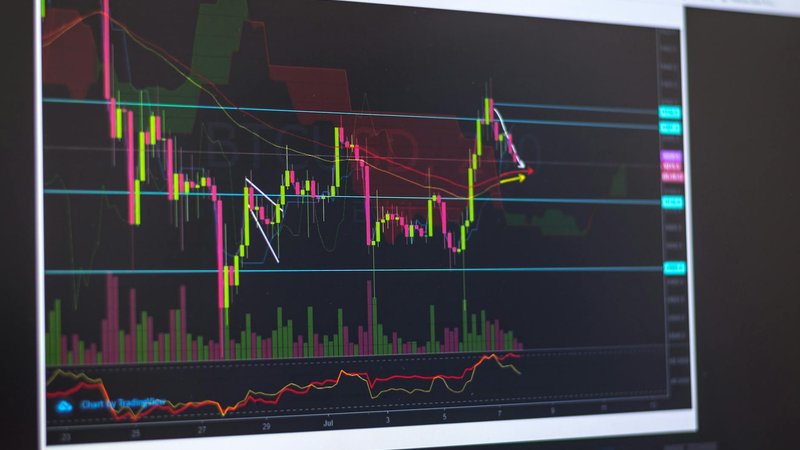
Your first take profit should almost always sit just below the next significant resistance level, not at it. If resistance is $95,000, set your target at $94,800. Sellers stack orders at round numbers and prior highs. Get filled before the wall, not into it.
Using Fibonacci Extensions for Trend-Following Take Profits
For breakout trades with no obvious resistance overhead, Fibonacci extensions provide objective targets. The 1.272 and 1.618 extensions of the prior swing are where momentum trades commonly exhaust. Use 1.272 for your second partial, 1.618 for your third.
RSI Divergence and Overbought Readings as Exit Confirmation
When daily RSI prints above 75 and starts showing bearish divergence — price making higher highs while RSI makes lower highs — that's your signal to accelerate exits. It doesn't mean reverse. It means tighten stops and dump remaining laddered tranches.
Adjusting Target Distance for High-Volatility Altcoins vs. Bitcoin
Bitcoin's daily ATR usually sits at 2-4%. A mid-cap alt might run 8-15%. If you apply Bitcoin-sized targets to an altcoin, you'll cap your gains at the first leg. Scale targets to the asset's average daily range — multiply BTC-style targets by roughly 2-3x for liquid alts and 4-5x for low-cap movers.
Common Mistakes When Setting Take Profit Levels
Moving Your Target Higher Mid-Trade and Giving Back Gains
You set $95,000. Price hits $94,500 and you "feel" it's going to $100,000. You cancel the order. Price reverses to $89,000. This is the single most expensive habit in retail trading. Once set, your target is sacred until structure objectively changes.
Setting Take Profits Without Accounting for Exchange Fees and Slippage
A 1:1.5 setup looks fine on paper. After fees, slippage, and funding on a multi-day perp hold, it might be 1:1.2. Always model real net return before entering.
Using Bull Market Rules in a Range-Bound or Bear Market
Trailing stops in a chop kill you. Fixed targets in a bull market leave 50% of the move on the table. Identify the regime first — is BTC above or below its 200-day moving average? — then pick your method.
Forgetting Tax Events When Planning Partial Profit Taking
Every partial exit is a taxable event in most jurisdictions. Selling 25% four times across a trade generates four reportable transactions. Track them as you go. End-of-year reconciliation is brutal if you don't.
Build the Habit Before You Need It
A pre-defined take profit framework applied consistently is what separates traders who compound from traders who churn. The formula is not complicated: define your stop, multiply your risk by 2 or more, cross-check structure, account for friction, then ladder out. Apply it on your next trade. Then the one after that. Within 30 trades you'll have data on your own win rate and average R, and the system improves itself.
Frequently Asked Questions
A good take profit level is one that gives you at least a 1:2 risk/reward ratio measured from your entry price relative to your stop-loss. For trend trades, target 1:3 or higher. The level should also align with the next significant resistance zone or Fibonacci extension to maximize the chance of getting filled.
Staged exits — also called laddered or partial profit taking — outperform single exits in most market conditions. A common template is selling 25% at 1R, 25% at 2R, 25% at 3R, and trailing the final 25%. This locks in gains while keeping exposure to extended moves.
On Binance, use the "TP/SL" toggle when placing a spot or futures order, then enter your trigger price and order type. On Coinbase Advanced, use a "Stop Limit" or "Bracket" order to set take profit and stop-loss simultaneously. Both platforms allow you to attach exits at the moment of entry, which is exactly when you should set them.