Crypto Trading Basics: Beginner's Starter Guide

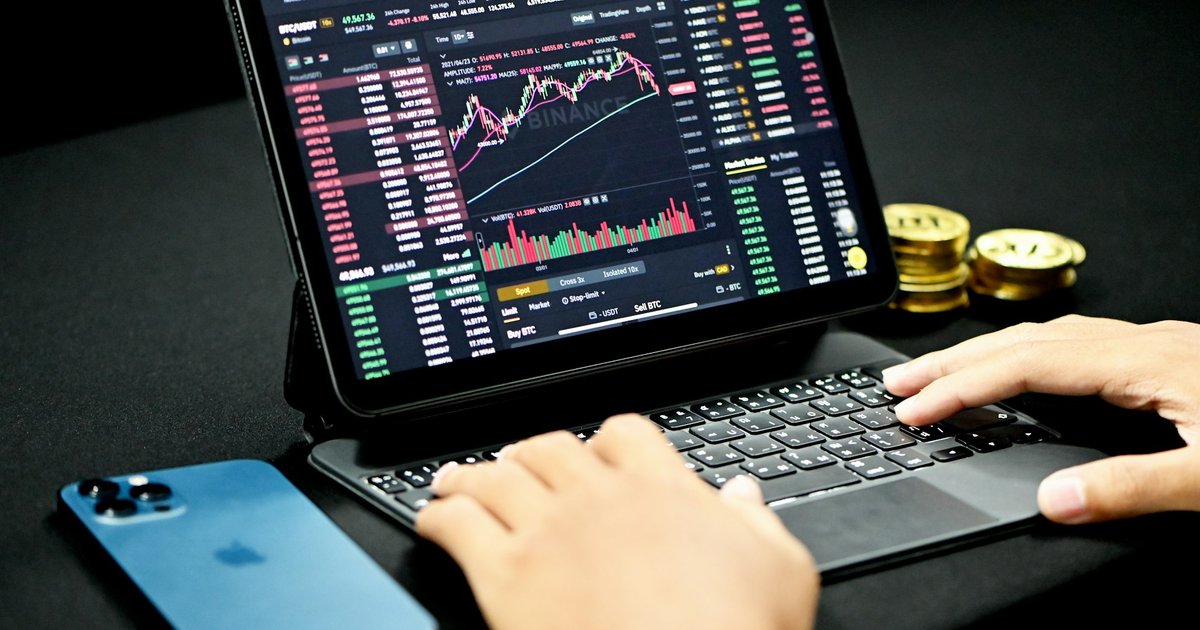
Table of Contents
Before you open a single chart or read about strategies, answer one question: are you here to invest, speculate, or learn the market? Your answer changes everything — the exchange you pick, the amount you risk, the timeframe you trade, and whether you should even touch a futures contract in your first year.
This guide walks you through crypto trading basics the way an experienced trader would coach a friend: a decision tree first, then exchange setup, then a real first trade with small money, then the five mistakes that drain most beginner accounts within 90 days.
What Crypto Trading Actually Means
Crypto trading is the act of buying and selling digital assets to profit from price movement. You're not buying Bitcoin because you believe in the technology — you're buying it because you think the price will be higher when you sell. That's the entire game.
Buying vs trading: what changes when you try to profit from price moves
When you buy and hold, you ignore short-term price noise. When you trade, every candle matters. You need an entry, an exit, and a reason for both. The mental shift is bigger than most beginners expect.
How a market order and limit order actually work
A market order fills instantly at the best available price. Fast, but you accept whatever price the order book gives you. A limit order lets you set the exact price you want — it only fills if the market reaches you. Beginners should default to limit orders. Market orders on low-liquidity coins can cost you 1-3% in slippage before you even start.
What the order book tells you about supply and demand
The order book is a live list of buy orders (bids) and sell orders (asks). Stacked bids below price mean buyers are waiting to defend. Heavy asks above mean sellers want out. Reading the book is a skill — but even a 30-second glance tells you whether liquidity is thick or thin before you click buy.
Crypto Trading vs Investing vs Speculation
Most beginners blur these three together and lose money because of it. The strategy that works for an investor will bore a day trader. The risk a speculator takes will wipe out an investor. Pick one before you fund an account.
Investing: buying and holding for long-term growth
You buy Bitcoin or Ethereum, store it safely, and hold for years. You ignore daily moves. You add to your position on dips. This is the path with the highest historical win rate for crypto retail participants — and it requires the least skill.
Trading: timing entries and exits for shorter gains
Swing trading means holding positions for days to weeks based on technical or fundamental setups. This is the realistic next step after you've held crypto and want to do more. Expect to be wrong 40-50% of the time even when you're competent.
Speculation: high-risk bets most beginners should avoid first
Memecoins, 50x leverage, low-cap altcoins. The risk-reward looks tempting on Twitter, but according to CoinGlass data, over $400 million in long positions get liquidated on a single bad day for Bitcoin during volatile weeks. Speculation belongs at the end of your learning curve, not the start.
Which path fits your time, capital, and risk tolerance
If you have less than five hours per week, invest or DCA. If you have time to study charts daily and a stomach for losses, learn swing trading. If you want to gamble, accept that's what you're doing and only use money you can lose entirely.
How to Choose the Right Exchange or App
Your exchange is your trading infrastructure. A bad one bleeds you through fees, fails when volume spikes, or — worst case — disappears with your funds. FTX wasn't ancient history. Pick carefully.
Centralized vs decentralized exchanges: what beginners should know
Centralized exchanges (Binance, Coinbase, Bybit, Kraken) hold your funds and offer the smoothest interface for spot trading for beginners. Decentralized exchanges (Uniswap, dYdX) let you trade from your own wallet but come with gas fees, MEV risks, and a steeper learning curve. Start centralized. Move to DEXs once you understand what you're doing.
Fee structures to compare before you sign up
| Fee type | Typical range | Why it matters |
|---|---|---|
| Maker fee | 0.00% - 0.10% | Paid when you add liquidity (limit orders) |
| Taker fee | 0.05% - 0.40% | Paid when you remove liquidity (market orders) |
| Withdrawal fee | Flat per asset | Can eat 1-5% on small withdrawals |
| Spread | 0.01% - 1%+ | Hidden cost on illiquid pairs |
Here's the math beginners miss: if you trade a $100 position with a 0.10% taker fee in and out, you've paid $0.20 in fees. Sounds small. Do that 50 times in a month and you've burned $10 — a 10% drag on a $100 account before market moves.
Custody and security: keeping your funds safe
Enable two-factor authentication using an authenticator app, not SMS. Use a unique password from a password manager. For balances above $1,000, move long-term holdings to a hardware wallet like Ledger or Trezor. Exchanges are for trading, not storage.
Red flags that signal a platform is not trustworthy
- Guaranteed returns or "risk-free" yield products
- No proof of reserves or audit history
- Recently launched with anonymous founders
- Aggressive influencer promotion paired with sign-up bonuses
- Withdrawal complaints flooding Reddit or Trustpilot
Your First Trade: A Simple Step-by-Step Walkthrough
This is the seven-day plan. Follow it exactly. Don't skip days, don't increase size, don't add coins to your watchlist that aren't on the plan.
Day 1 to 2: account setup, verification, and funding
Pick one major exchange. Complete KYC verification — this can take 24-48 hours. Enable 2FA. Fund the account with a small amount you've already mentally written off. Don't touch anything yet.
How much money to start with and how to size your first trade
Start with $50 to $200. That's enough to feel real but small enough that losing it teaches a cheap lesson. Your first trade should risk no more than 1-2% of that — meaning if your stop-loss hits, you lose $1 to $4. That's the right size. Anything bigger and emotion takes over.
Placing your first spot trade using a limit order
Choose a liquid pair — BTC/USDT or ETH/USDT. Look at the current price. Set a limit order slightly below market (say 0.5% under) to get a maker fee discount. Enter your position. Immediately set a stop-loss and a take-profit level. Walk away.
Day 5 to 7: reviewing your trade and logging what you learned
Whether you won or lost, write it down. Entry price, exit price, why you took the trade, what you felt while holding it. A trade journal is the single highest-ROI habit in trading. Most beginners skip it. Most beginners also quit within six months.
Once you've placed your first spot trade and logged the outcome, you'll start wondering how experienced traders spot setups consistently. XeroGravity scans the market 24/7 and delivers AI-powered signals with entry, take profit, and stop loss levels. Try it free.
Risk Management Basics Every Beginner Needs
Profitable traders aren't the ones who pick the most winners. They're the ones who lose small and win bigger. Risk management is the entire job.
What a stop-loss is and how to set one on your first trade
A stop-loss is an automatic sell order that triggers if price drops to a level you define. It caps your loss without requiring you to watch the screen. Set it at a logical technical level — below a recent swing low, not at a random round number. Move it only to reduce risk, never to give a losing trade more room.
Position sizing: never risk more than you can afford to lose
The 1% rule: never risk more than 1% of your account on a single trade. On a $200 account, that's $2 of risk per trade. This sounds tiny. It's also why professional traders survive losing streaks that wipe out amateurs.
Slippage and fees: the hidden costs that erode small accounts
On a $100 trade in an illiquid altcoin, you might pay a 0.5% spread, 0.10% taker fee, and another 0.3% slippage. That's nearly 1% gone before the trade moves a cent. This is why beginners should stick to BTC, ETH, and top-20 coins until they understand liquidity.
Paper trading as a zero-risk way to practice before going live
Most major exchanges offer demo accounts. Use them. Place 20-30 paper trades before risking real capital. You'll learn the platform mechanics, test your reactions to losses, and avoid expensive UI mistakes like clicking sell when you meant buy.
Five Beginner Mistakes That Wipe Out Most New Traders
These five errors account for the vast majority of blown beginner accounts. Each one is preventable.
Chasing price pumps driven by social media hype
By the time a coin is trending on Twitter, the move is mostly done. Buying the top of a pump means you're exit liquidity for someone who entered hours earlier. If you didn't have a plan to buy it before the pump, you don't have a plan to buy it during one.
Trading without a plan or defined exit strategy
"I'll sell when it goes up" isn't a plan. Define your entry, stop-loss, take-profit, and position size before you click buy. If you can't write it on one line, don't take the trade.
Ignoring fees until they consume most of your profit
Overtrading is the silent killer of small accounts. 50 trades a month at 0.20% round-trip costs you 10% of capital in fees alone. Trade less, trade better.
Using leverage before mastering spot trading basics
5x leverage means a 20% move against you liquidates your entire position. New traders see leverage as a shortcut to bigger gains. The exchanges see it as a shortcut to your capital. Master spot trading for at least six months before touching futures.
Falling for giveaway scams and fake signal groups
No one is sending you free Bitcoin. No Telegram group with 10,000 members is giving you accurate trade calls for $50/month. If someone DMs you about a "10x opportunity," block them. Real signal providers — like the AI-powered service at XeroGravity — are transparent about results and don't cold-message anyone.
Where to Go From Here
Go back to the decision tree at the top of this guide. If you identified as an investor, set up a DCA schedule and stop reading trading content. If you identified as a trader, complete the seven-day plan with real money — small money — and journal every trade. Don't add complexity until you've placed at least 30 trades and reviewed them honestly.
Once you're comfortable with spot trading mechanics, the next leap is reading setups consistently. That's where most self-taught traders plateau — they can place trades but can't find the right ones reliably. Data-driven tools bridge that gap.
Scanning the market for setups like this manually takes hours. XeroGravity does it automatically — AI-powered signals with entry, take profit, and stop loss levels delivered to your dashboard in real time. Start free.
Frequently Asked Questions
Crypto trading carries real risk of losing your entire deposit, especially when using leverage or trading low-cap altcoins. Beginners can trade safely by starting with small amounts ($50-$200), using only spot trading on major exchanges, setting stop-losses on every trade, and avoiding leverage until they have at least six months of experience.
You can start with as little as $50 to $200 on most major exchanges. The goal at this stage is education, not profit — small amounts teach you the mechanics without risking money you can't afford to lose. Scale up only after you've completed 30+ trades and can prove a consistent process.
Spot trading means buying the actual cryptocurrency and owning it — your maximum loss is the amount you invested. Futures trading uses leveraged contracts that magnify both gains and losses, and your position can be liquidated automatically if price moves against you. Beginners should stick to spot trading until they fully understand risk management.