Contents
- 01A rug pull is an exit scam where insiders take the value and leave
- 02How a rug pull works: 5 stages from hyped launch to unsellable token
- 03Hard vs soft rugs: 4 methods insiders use to drain a token
- 04What malicious contract code can look like: sells blocked for everyone but insiders
- 05Warning signs to check before you buy: 4 red flags visible on-chain
- 06Rug pull vs exit scam vs pump and dump: the lines are loose
- 07If you've been rugged, recovery is hard because crypto has no chargeback
- 08Rug pullers are hard to prosecute: 2 darknet exit scams worth $12 million and $14.2 million
- 09Rug pull as slang: any sudden reversal of support
A rug pull is a crypto scam in which a token's insiders abandon it and cash out its value. Sardine's rug pull glossary lists 4 insider moves: liquidity removal, mint and dump, disabled sells and hidden functions.
Protection has to come before the purchase. Wikipedia's exit scam entry notes that crypto payments are irreversible and cannot be recovered through a chargeback.
Before buying, check the token's liquidity, supply, contract permissions and team. Sardine says the warning signs are visible before the pull.
Rug pulls in numbers
A CertiK study found that 48.14% of new Ethereum tokens launched between November 2023 and early August 2024 were linked to rug pull schemes (certik.com).
Solana rug pull tokens identified in early 2025 caused at least $151 million in directly traceable losses (deepstrike.io).
This article is general information, not financial advice. Check current rates and fees with the provider, and consider a qualified adviser for your own situation.
A rug pull is an exit scam where insiders take the value and leave
Wikipedia's exit scam entry treats "rug pull" as another name for an exit scam. It defines that as a confidence trick or fraud, perpetrated under the guise of a legitimate business
.
The scheme ends when the originator leaves with participants' funds.
Sardine's rug pull definition applies the idea to tokens. In this version, insiders abandon a token and cash out its value.
The name describes a rug being yanked out from under everyone who bought in.
Sardine names three common ways insiders cash out: pulling liquidity, minting and dumping, and disabling sells. Each method depends on something insiders control.
Before you buy, check all three:
- Liquidity: can insiders remove the pool you would sell your tokens into?
- Supply: do insiders hold a large share, or can they mint more tokens and sell them?
- Contract permissions: does the code let insiders block your sells or change the rules after you buy?
See KOL calls and smart-wallet buys as they happen →
How a rug pull works: 5 stages from hyped launch to unsellable token
On a decentralized exchange, you usually sell a token into a liquidity pool. The pool is a reserve of a paired currency that your tokens swap into when you sell.
If insiders control that reserve or most of the token supply, they control whether you can exit. For context on where these tokens trade, see our meme coin trading platform guide.
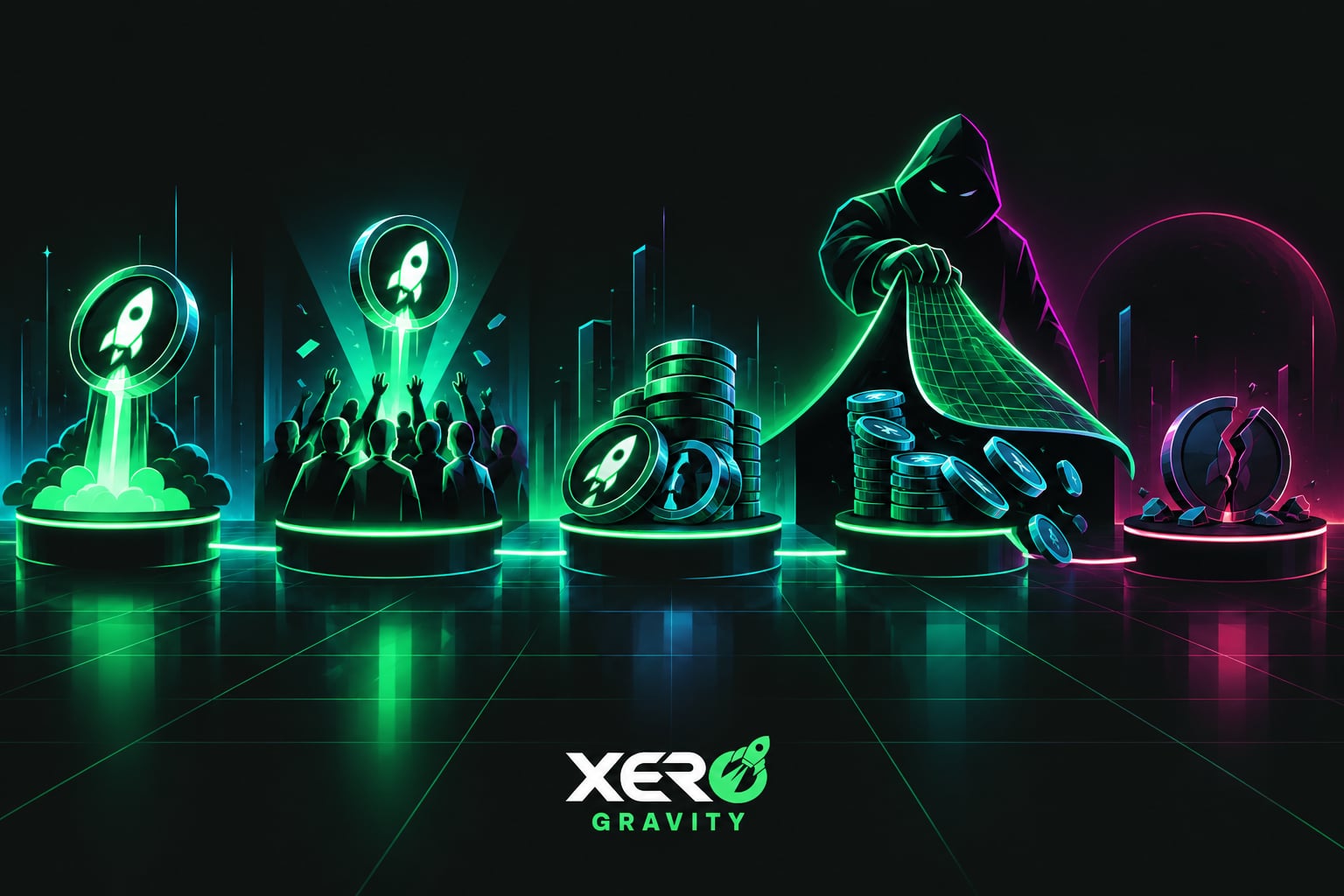
The five stages below are an illustrative sequence, not a documented case. They follow the methods described in Sardine's rug pull explainer.
- The team launches a token and keeps a large share of the supply, contract permissions, or both.
- The team pairs the token with another currency in a pool. Buyers can then swap in, and holders can sell back out.
- Promoters build demand. Sardine notes that these hype-drivers are sometimes paid and occasionally do not know about the plan.
- Buyers swap in, adding paired currency to the pool.
- Insiders withdraw the liquidity or dump their supply into the pool. They leave with the currency that buyers added.
Why a price can still show after the pool is empty
After the pull, your wallet may still show a token balance and a recent price. Sardine explains that once insiders withdraw the liquidity, holders can no longer sell the token for real value, even if a price still displays.
A displayed price is useful only when the pool holds enough reserve to sell into. Before you buy, check whether you could actually exit, not just whether the chart shows a price.
Hard vs soft rugs: 4 methods insiders use to drain a token
Sardine's rug pull glossary defines a hard rug as code or actions that steal funds outright, such as draining liquidity or disabling sells. A soft rug is a slower abandonment in which insiders dump their holdings and walk away.
Coinbase's rug pull guide separates the two by timing. A hard rug can cost participants all their assets within a short time.
In a soft rug, the core team keeps up a false sense of security while it quietly shuts down.
Sardine lists four methods: liquidity removal, mint and dump, disabled sells and hidden functions. The last column below is our own mapping to Sardine's hard and soft examples, because Sardine does not label every method.
| Method | What insiders do | What holders experience | Closest fit |
|---|---|---|---|
| Liquidity removal | Withdraw the pool that buyers sell into | The token still shows a price, but holders cannot sell it for real value | Hard (Sardine's own example) |
| Mint and dump | Create tokens and sell their own holdings | Insiders cash out by selling, and holders are left with the token | Soft, where it matches Sardine's dump-and-walk-away description |
| Disabled sells | Code the contract so ordinary holders cannot sell | Holders' sell attempts fail, but insiders can still sell | Hard (Sardine's own example) |
| Hidden functions | Use malicious code to drain funds or change rules | The token's rules change after holders have bought in | Hard, when the code drains funds |
Coinbase uses a broader list of types: liquidity pulls, fake projects, pump and dump schemes, and team exits. In our reading, Coinbase's types describe how a project is promoted and abandoned.
Sardine's methods describe which on-chain lever was pulled.
What malicious contract code can look like: sells blocked for everyone but insiders
A token's smart contract decides who can trade, create supply and change the rules. That means a rug pull can be built in before launch.
Sardine's table of rug pull methods includes "disabled sells," where the code stops ordinary holders from selling while insiders still can.
Example: Sells blocked while insiders still can exit
In that case, the contract can let insiders sell while blocking you. In a hypothetical example, your purchase goes through and the chart looks normal.
You find the problem only when your sell order fails.
Sardine also lists hidden functions. These are malicious code paths that let insiders drain funds or change the rules after people have bought.
On a verified contract page, look for powers held by a single owner address that match these methods:
- Minting new supply, which enables mint and dump.
- Blocking or pausing transfers, which can disable sells.
- Changing rules or ownership after launch, which is what hidden functions exploit.
If one wallet still controls these powers, insiders have the means to rug the token, whatever its marketing says. The checklist in the next section covers audits and the other signs to review.
Warning signs to check before you buy: 4 red flags visible on-chain
Sardine's rug pull guide names four warning signs: a large insider share, unlocked or removable liquidity, unaudited or malicious contract functions, and an anonymous team. Sardine says all four are visible before the pull if you look.
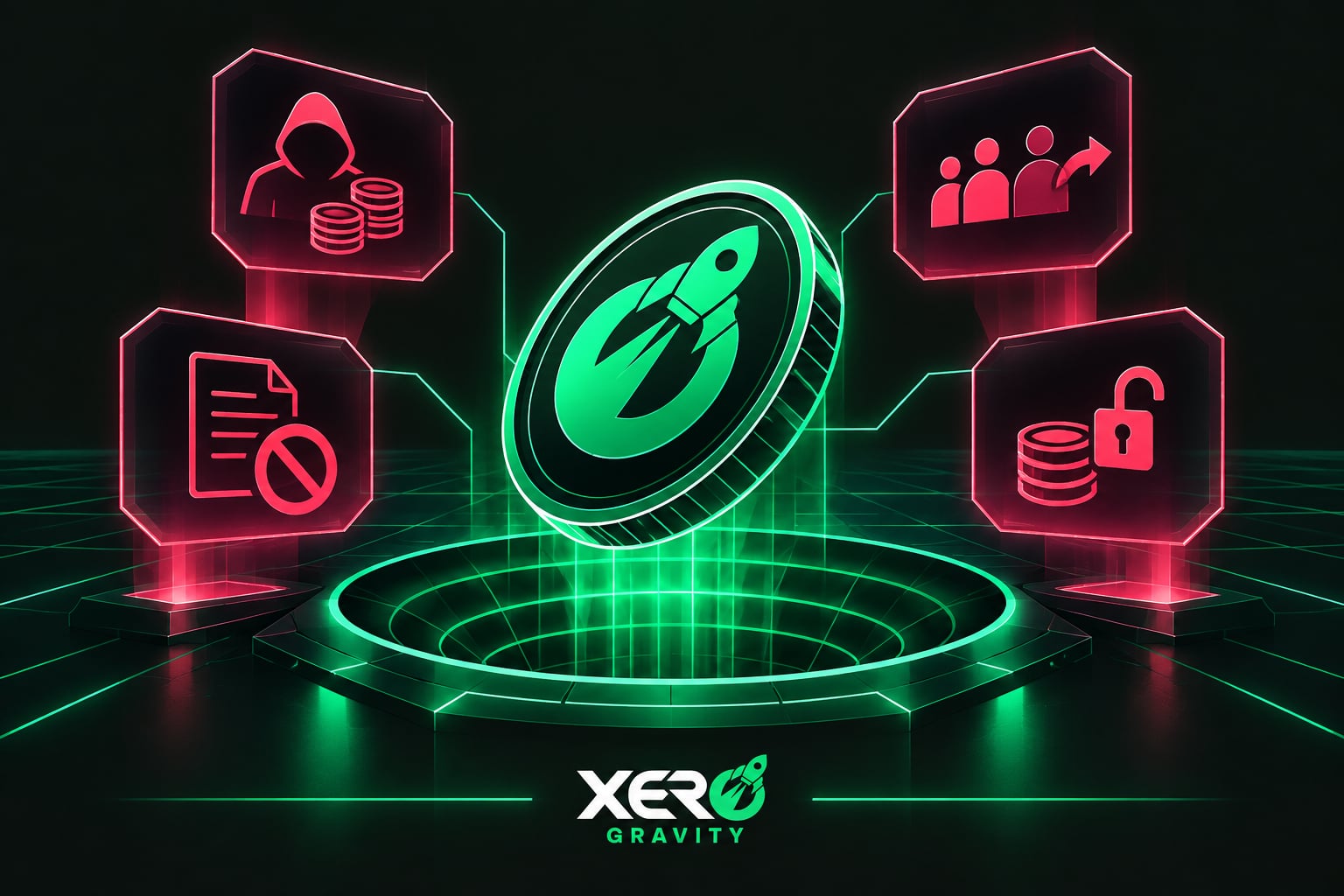
Three of the four signs appear on-chain in the token's holders, pool and contract. The team check happens on the project's own pages.
| Red flag | What to check | Where to start |
|---|---|---|
| Large insider share | How much supply the deployer and top wallets hold | The token's holder list, or a wallet tracking tool |
| Unlocked or removable liquidity | Whether insiders can withdraw the pool that buyers sell into | The token's liquidity pool details |
| Unaudited or malicious functions | Whether a third-party audit exists and what it reports | The audit report and the verified contract page |
| Anonymous team | Whether named people stand behind clear, specific project goals | The project's website and social accounts |
Coinbase recommends checking for a third-party security audit and reading the report for vulnerabilities. A project's claim that it was audited does not tell you what the auditors found.
Bitso lists more red flags: an unknown team or vague goals, promises of extraordinary short-term profits, unexplained price spikes, and a suspicious or inactive community. For context on crypto chat communities, see our Telegram group guide.
Promotion itself is not evidence that a token is safe. Coinbase notes that some scams use trusted figures to gain buyers' trust, and Sardine says hype-drivers are sometimes paid.
Our crypto KOL guide covers the accounts traders follow. Run the four checks no matter who is promoting the token.
Passing every check lowers your exposure but does not guarantee safety. Sardine's signs show what insiders are able to do, not what they will do.
Rug pull vs exit scam vs pump and dump: the lines are loose
Sardine's rug pull glossary treats exit scam as the broader idea of operators taking the money and vanishing. It treats rug pull as the DeFi version centered on a token, and it says the distinction between the two terms is loose.
Coinbase's guide to rug pull types draws the boundary in a different place. It counts pump and dump as one type of rug pull, alongside liquidity pulls, fake projects and team exits.
Wikipedia's exit scam entry uses "exit scam" and "rug pull" as names for the same fraud.
Because the sources disagree on labels, it is more useful to ask which lever insiders pulled. The categories below follow Sardine's methods and its hard and soft definitions:
- If insiders withdrew the trading pool, the event was liquidity removal, a hard rug.
- If ordinary holders could not sell but insiders could, the contract disabled sells, which is also a hard rug.
- If insiders dumped their holdings and walked away, Sardine calls it a soft rug, and Coinbase's pump-and-dump label also fits.
- If the pool stayed funded, sells worked and insiders kept their tokens, a falling price alone does not show that insiders pulled any lever.
If you've been rugged, recovery is hard because crypto has no chargeback
Wikipedia's exit scam entry notes that crypto payments are irreversible and cannot be recovered through a chargeback. A card issuer cannot reverse the purchase for you.
Bitso's rug pull guide warns that recovering funds can be difficult. These steps can limit further damage and support any report you file:
- Record your wallet address, the token's contract address and your transaction details. Tracing work involves following funds and flagging addresses, so these records give responders a place to start.
- Contact the platform you traded on and your local authorities, as Bitso advises.
- Change any passwords that may have been exposed, which Bitso also recommends.
- Expect no guaranteed outcome. Sardine's rug pull explainer says responders trace extracted funds toward cash-out venues, flag attacker addresses and alert exchanges.
Sardine says recovery is hard, so prevention and fast tracing matter most. Report the loss promptly rather than waiting.
This article cites no official consumer-protection source. Check your local authority's guidance on reporting crypto fraud. Both Bitso and Sardine describe recovery as difficult, so treat any offer of guaranteed recovery with suspicion.
Rug pullers are hard to prosecute: 2 darknet exit scams worth $12 million and $14.2 million
Both figures come from Wikipedia's exit scam entry, and both cases are darknet markets, not tokens. Evolution's administrators apparently left with $12 million in bitcoin held in escrow on the marketplace.
Note
In the Wall Street Market exit scam, $14.2 million in crypto was stolen in 2019 just before authorities seized the site.
Wikipedia says darknet anonymity makes prosecution difficult. It adds that victims who knowingly took part in illegal activity usually cannot go to law enforcement.
Token rugs keep happening for a related reason. Sardine's rug pull explainer says anyone can launch a token and a trading pool with little friction and no gatekeeper.
Scammers can therefore set up convincing projects cheaply and repeatedly.
For buyers, the possibility of a later arrest does not protect your money. The checks you make before buying are the part you control.
These two cases are darknet market exit scams, not token rug pulls. Wikipedia also cites two secondary estimates: Satis Group's figure that 80% of 2017 ICOs were scams of this type, and exit scam damage of more than $4.3 billion in 2019. Both estimates are dated.
Rug pull as slang: any sudden reversal of support
Outside fraud cases, traders also use "rug pull" loosely for any sharp reversal. In this casual sense, the term can describe an asset that collapses even though no insider took anyone's money.
On March 26, 2026, Shay Boloor wrote What a rug pull in $VCX
in a post on X about the $VCX ticker. $VCX is not a crypto token.
Boloor described it as a popular way to get exposure to names such as Anthropic, OpenAI and SpaceX.
Boloor gave his reasoning in the same post. The ticker had run 10x in a week and was trading around 25x NAV, which he called a very obvious short
.
His point was about a stretched valuation, not insiders draining funds.
That author defines the term more narrowly: the team pumps the project, then disappears with the funds and leaves investors holding a worthless asset.
When you decide whether a loss was fraud, keep in mind that a sharp drop alone is not a rug pull. Ask whether insiders removed liquidity, minted and dumped supply, or blocked sells.
Sardine's rug pull explainer lists these as common methods.
If none of those levers moved, "crash" or "reversal" is the more accurate word.
Watching every KOL channel and smart-money wallet by hand is a full-time job. XeroGravity does it for you — live KOL and wallet signals with win rates, one-click buys, and autopilot with take profit and stop loss on Solana and Robinhood chain.
Frequently Asked Questions
Authorities sometimes act, but prosecution is difficult. Wikipedia's exit scam entry reports that authorities seized Wall Street Market in 2019, just after $14.2 million in crypto was stolen. It also says darknet anonymity makes prosecution difficult. Fraud law varies by jurisdiction, so check how your local authority handles these cases.
In casual use, a rug pull is any sharp reversal that catches buyers off guard. Shay Boloor's March 2026 post on X used “What a rug pull in $VCX” about a non-crypto ticker that had run 10x in a week. In crypto fraud, the term is narrower: insiders drain liquidity, dump supply or block sells.
Before you buy, check four things: how much supply insiders hold, whether liquidity is unlocked or removable, whether the contract is unaudited or has malicious functions, and whether the team is anonymous. Sardine says these signals are visible before the pull. Bitso adds extraordinary profit promises, unexplained price spikes and an inactive community. None of these checks guarantees that a token is safe.
For scammers, it often does. Sardine notes that anyone can launch a token and trading pool cheaply with no gatekeeper. Wikipedia points out that crypto payments cannot be reversed through a chargeback, and it cites a dated Satis Group estimate that 80% of 2017 ICOs were scams of this type.
Sardine defines a hard rug as code or actions that steal funds outright, such as draining liquidity or disabling sells. A soft rug is a slower abandonment in which insiders dump holdings and walk away. Coinbase adds that in a soft rug, the team gives holders a false sense of security while it quietly shuts down.
The two terms are very close. Wikipedia uses them as synonyms. Sardine calls the line loose: exit scam is the broader idea of operators taking money and vanishing, and rug pull is the DeFi version built around a token's liquidity or contract.
Rarely, because crypto payments cannot be reversed with a chargeback. Bitso advises contacting the platform and local authorities and changing exposed passwords, and it warns that recovery can be difficult. According to Sardine, responders trace funds toward cash-out venues and alert exchanges, and it says fast tracing matters most.
Watch the live feed
KOL calls, smart-wallet buys and real-time momentum on every live pump.fun token. Free to watch — no sign-up.